Budget Excel: free budget template and cash flow statement for entrepreneurs
With this free budget Excel template you can make your company's budget and a 12-month cash flow forecast in the same file. The budget tells you whether you will make a profit. The cash flow statement shows month by month how much money comes into the account, how much goes out and what the balance is at the end of the month. The template sets aside the VAT liability and income tax, so you can see how much of the money in the account is really yours.
Free, no sign-up. A standard .xlsx or .docx file.
The template itself is in Finnish, as used in Finland.
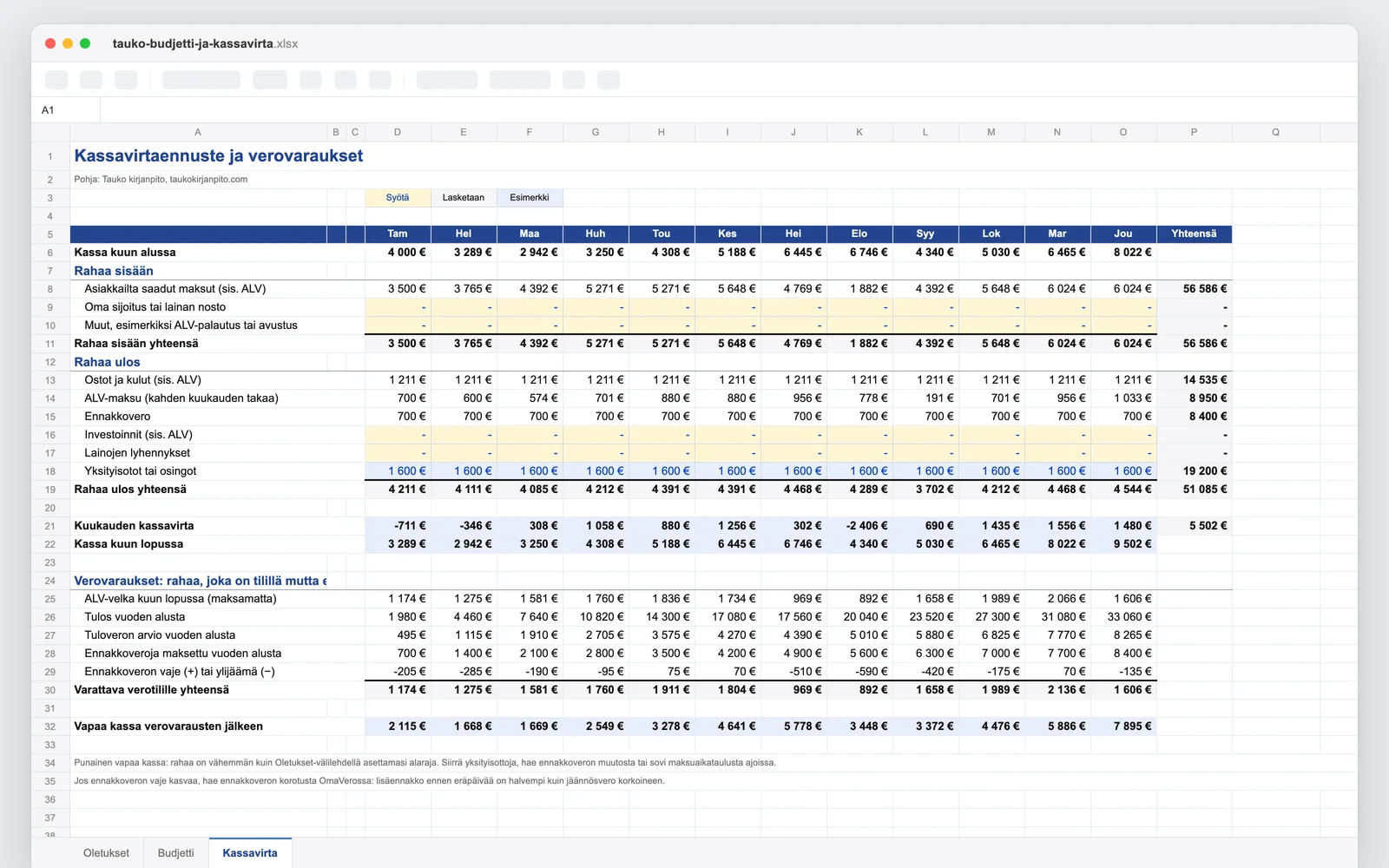
What's in the template
- Budget for 12 months excluding VAT: revenue, variable and fixed costs, gross margin, EBITDA and result
- A cash flow forecast that takes your customers' payment delay into account (same month, one month or two months later)
- VAT payment in the right month: the VAT for a month is paid on the 12th day of the second month after it
- Prepaid tax check: estimated income tax for the year to date compared with prepaid tax paid
- A row for Free cash after tax reserves that turns red when money runs low
- Example figures for a sole trader that you replace with your own
How to use the template
- 1Enter the starting figures
On the Assumptions tab, enter the account balance on 1 January, the prepaid tax amount from your prepaid tax slip, an estimated tax rate and how quickly your customers pay.
- 2Make the budget excluding VAT
Enter sales and costs for each month excluding VAT. The VAT % column tells the template at which rate the row is invoiced or purchased.
- 3Add money movements that are not expenses
On the Cash flow tab, enter investments, loan drawdowns and repayments, and private withdrawals. They take money out or bring it in, even though they do not appear in the result.
- 4Check the free cash
The last row tells you how much money is left once the VAT liability and the upcoming tax have been set aside. A red month is a sign to act now, not when the account is already empty.
- 5Update monthly
Replace the forecast with actual figures when each month ends. After three months the forecast is already much more accurate than at the start of the year.
Budget and cash flow are not the same thing
The budget tells you whether you will make a profit. Cash flow tells you whether the money will last. A business can be profitable and still run into payment difficulties if customers pay a month late, VAT falls due in a quiet month and prepaid tax has been underestimated.
In the template's example, the sole trader's result is just over €33,000 a year, but in February and March free cash drops below the €2,000 minimum that has been set. The reason is not poor sales but timing: the VAT for December and January is paid just when the invoices from early in the year are still unpaid by customers. More on this in the article cash flow management.
How do you make a budget in Excel?
A budget is made in Excel in five steps. First estimate sales month by month. Then enter the variable costs that follow sales. Add fixed costs such as rent, software and insurance. Add your own YEL and your target income for yourself. Finally, see what is left as the result. All figures are entered excluding VAT, because VAT is neither income nor an expense for the business.
A worked budget example: a consultant expects to invoice €6,000 a month for ten months and €3,000 in July and December, €66,000 in total. Software, phone, insurance and bookkeeping are €700 a month, or €8,400 a year, and YEL on earned income of €30,000 is €7,320. The result before taxes is €50,280. When the same budget is taken into the template's cash flow forecast, you can see that after the quiet months VAT and prepaid tax fall due just when there is least money in the account.
The formulas in the template are ready, so you only enter figures in the yellow cells. The template works in Excel, Google Sheets and Numbers.
Business budget or household budget?
A household budget tracks salary, housing, food and bills. Ready-made household budget templates and money diaries are offered by, for example, Martat, the Guarantee Foundation (Takuusäätiö) and the Consumers' Union of Finland (Kuluttajaliitto), and Excel's own templates include a personal budget. But they lack what is hardest about an entrepreneur's money: VAT, prepaid tax, YEL and customers' payment delays.
This template is a business budget. An entrepreneur's household and business meet on one row: private withdrawals or your own salary. When the business budget shows how much you can take out each month after the tax reserve, that same figure is the income row of your household budget. That way you don't budget money for your home that belongs to the tax authority.
What is a cash flow statement?
A cash flow statement shows month by month how much money comes into the company's account, how much goes out and what the balance is at the end of the period. It describes the company's liquidity, that is, whether the money will be enough for bills, taxes and your own pay, whereas the income statement only tells you whether you make a profit.
The difference shows up in every business. An invoice is recorded as a sale on the day it is sent, but the money only reaches the account on the due date. VAT is neither income nor an expense, but it passes through the account. A loan repayment takes money even though it is not an expense. The cash flow statement brings all of these into the same table, which is why it warns of a cash shortfall months before the income statement shows anything unusual.
For a small business, a cash flow statement is a voluntary tool. The statutory version is the cash flow statement in the financial statements, and the Finnish Accounting Act only requires it from large companies. The differences between the types of statement are collected in the article cash flow statements.
How do you make a cash flow statement?
A simple cash flow statement has four rows: the balance at the start of the month, money coming into the account, money going out of the account and the balance at the end of the month. Cash flow is calculated by subtracting outgoing money from incoming money. The closing balance is the next month's opening balance.
Record money in the month it actually moves, not the month the invoice was sent. That is why the template has the customers' payment delay, the VAT payment on the 12th day of the second month and separate rows for loans, investments and private withdrawals.
A worked cash flow example: at the start of the month there is €6,000 in the account. Customers pay €9,000 including VAT. €3,100 goes out on purchases and expenses, €600 on the YEL contribution, €900 on prepaid tax, €1,400 on the previous month's VAT and €2,500 on private withdrawals. Cash flow is 9,000 − 8,500 = €500, and the balance at the end of the month is €6,500. The template calculates the same automatically and finally also deducts the tax reserve.
Look at two rows of the figures. The month's cash flow tells you whether money grew or shrank in that particular month. The month-end balance tells you how much money is available once all previous months are taken into account. One negative month is normal if the balance can absorb it. If the forecast balance drops below your buffer or goes negative, you still have time to postpone a purchase, speed up invoicing or seek financing. The Excel structure and formulas are explained in more detail in the article cash flow statement in Excel.
What goes into a cash flow statement and what doesn't?
A cash flow statement includes all money that moves through the company's account, and only that. Coming in: customer payments including VAT, owner's capital contributions or share capital, loans drawn, start-up grant and other subsidies, and VAT refunds. Going out: purchases including VAT, rent, salaries and YEL, prepaid tax, VAT payments, loan repayments and interest, investments, and private withdrawals or dividends.
Depreciation does not belong in a cash flow statement. Depreciation is the bookkeeping way of spreading a machine's price over several years, and not a single euro leaves the account when it is recorded. The money goes out once, in the month the machine is paid for. Example (worked): you buy a machine for €12,000 (excl. VAT) in March. The cash flow statement shows an outgoing payment of €15,060 including VAT for March, and the €3,060 of input VAT comes back when it is deducted on the next VAT return. In the first year the income statement shows depreciation of no more than €3,000, because for tax purposes no more than 25 percent of the undepreciated balance of machinery can be depreciated a year. If you also put depreciation in the cash flow, the same money is deducted twice. More on depreciation in the article depreciation.
Check the VAT rates if you use an old template. The standard VAT rate has been 25.5 percent since 1 September 2024, and from the start of 2026 the rates are 25.5, 13.5 and 10 percent. Many cash flow statements downloadable online still calculate with 24 percent, which makes VAT payments too small in the forecast. In this page's template, the VAT rate is chosen row by row.
Cash flow statement for a loan application: what does the bank look at?
A bank or Finnvera usually asks for a cash flow statement or budget to be attached to a loan application, because it shows whether the money will cover loan repayments in quiet months too. From a new company, the statement is often requested as part of the business plan.
A lender first looks at the sales assumptions: is the estimate based on contracts, past sales or hope? Then it checks whether repayments and interest are recorded on their own rows and whether the balance stays positive every month after them. Finally it looks at the buffer, that is, whether the cash can withstand a month or two of weaker sales. Enter the loan drawdown and repayments on the template's Cash flow tab, and you will see the same as the lender. Read more: business loan for a new company and Finnvera financing.
Cash flow statement, cash flow forecast and statutory cash flow statement: what's the difference?
A cash flow statement can look back or forward. A statement made from actual figures tells you where the money went. A cash flow forecast is the same statement for the coming months, and it is what entrepreneurs need most often. This template does both: the forecast is replaced with actuals one month at a time.
The statutory cash flow statement (in Finnish "rahoituslaskelma") is part of the financial statements and is split into cash flows from operating, investing and financing activities. Under the Finnish Accounting Act it is only compulsory for large companies, so it is not needed in a small company's financial statements. It is still a good model for tracking your own cash.
Operating cash flow is the money received from sales less operating expenses and taxes. Free cash flow is what remains after also deducting investments, such as buying a car or a machine. Free cash flow tells you how much money is left for loan repayments, dividends or private withdrawals. The concepts are also explained in the glossary: cash flow statement.
Why calculate a tax reserve every month?
Not all the money in the account is yours. The VAT on your sales belongs to the state as soon as you have invoiced, and it is paid on the 12th day of the second month. Your result also generates tax, which prepaid tax may not cover. The template calculates both and shows the amount you can move to a separate account or straight to your tax account.
If the shortfall in prepaid tax grows, apply to increase your prepaid tax in OmaVero during the year. That way you pay the tax evenly and don't get back taxes with interest the following autumn. How prepaid tax is determined is explained in the article prepaid tax.
The most common budgeting mistakes
The first mistake is to estimate sales as one figure and divide it by twelve. July and December are quiet in many sectors, and your own holiday needs to be budgeted separately. In the template's example, July sales are less than half of a normal month.
The second mistake is to forget YEL or budget it wrongly. The YEL contribution is 24.4 percent of earned income in 2026, and a new entrepreneur gets a 22 percent discount for 48 months. Calculate your own contribution with the YEL calculator and enter it on the budget row.
The third mistake is to record an investment as a budget expense. A machine or car takes money out of the cash in one go, but it reaches the income statement as depreciation over several years. That is why in the template investments are recorded in the cash flow and depreciation in the budget.
When is a spreadsheet no longer enough?
An Excel forecast is only as good as its updates. When there are many transactions, the figures go out of date within a week, and a typical accounting firm's report often arrives a month or two late. At Tauko you can ask your accountant, for example, whether your prepaid tax matches your result, and advice is included in the fixed monthly price, which starts at €69/month for sole traders and €89/month for limited companies (excl. VAT). Financial statements are billed separately. See your own price, or if you already have an accounting firm but the reports come late, get a quote to compare with your current firm.
Frequently asked questions
What is a cash flow statement?+
A cash flow statement shows how much money comes into and goes out of the company's account each month and what the balance is at the end of the period. It describes liquidity: whether the money will be enough for bills, taxes and your own pay. It differs from the income statement in that it follows when payments actually happen.
Is the statutory cash flow statement the same as a cash flow statement?+
In practice, yes. "Rahoituslaskelma" is the Finnish Accounting Act's name for the cash flow statement included in the financial statements, split into cash flows from operating, investing and financing activities. It is only compulsory for large companies. An entrepreneur's own cash flow statement is usually a monthly forecast that the law does not require.
Does depreciation belong in a cash flow statement?+
No. Depreciation does not move money, so it belongs in the income statement and the budget. The cash flow statement records the full price of an investment in the month it is paid.
What is a cash flow forecast?+
A cash flow forecast tells you month by month how much money comes into and goes out of the account and what the balance is at the end of the month. It differs from a budget in that it takes into account the timing of payments, VAT and money movements that are not expenses.
How is cash flow calculated?+
Cash flow is the money that came into the account less the money that went out over the same period. Positive cash flow increases the balance, negative cash flow reduces it. Cash flow is not the same as the result, because VAT, loan repayments and investments, for example, move money but do not show in the result in the same month.
Does Excel have a ready-made budget template?+
Excel and Google Sheets have ready-made budget templates, but they are usually made for households. An entrepreneur's budget also needs VAT, prepaid tax, YEL and payment delay, and these are ready in this page's template.
Where can I get the Martat budget template?+
Martat publishes budget and money diary templates for managing household finances on its website. They are suited to tracking household spending. For your company's money, use a separate budget that includes VAT and taxes, such as the template on this page.
What is a good budgeting tool for a small business?+
For a small business, an Excel budget is perfectly adequate when it is updated monthly. This page's budget Excel template covers revenue, costs, cash flow and the tax reserve for 12 months. Separate budgeting software is worth considering when you have several units or employees to budget for.
Are budget figures entered including or excluding VAT?+
Excluding. The budget and result are calculated from figures excluding VAT. The template adds VAT to the cash flow itself, because customers pay their invoices and you pay for your purchases including VAT.
When is VAT paid?+
With a monthly period, the VAT for a month is reported and paid by the 12th day of the second month after it, for example January's VAT by 12 March. If your VAT period is a quarter or a year, the payments are less frequent but larger.
How much money should I keep as a buffer?+
A common rule of thumb is one or two months of fixed costs and your own pay. Enter the minimum on the Assumptions tab, and the template shows in red the months in which the cash falls below it.
Is the template suitable for a limited company?+
Yes. Enter your own salary on the Salaries and related costs row, dividends on the Private withdrawals or dividends row and the 20 percent corporate income tax as the tax rate. A limited company also pays its prepaid tax monthly.
Can the budget be changed during the year?+
It should be. A budget is a tool, not a promise. Update the actual figures monthly and revise the estimate for the rest of the year as you learn more. If the result differs a lot, apply to change your prepaid tax at the same time.