Business plan template: free Word template with instructions
A business plan, or company operating plan, sets out what you sell, to whom, how you stand out from competitors and how the money will last. This free business plan template helps you write it in ten chapters. Under each heading it explains what to write there and what the reader wants to see. The tables in the financial section match the financial calculations template, so the figures transfer straight into the plan.
Free, no sign-up. A standard .xlsx or .docx file.
The template itself is in Finnish, as used in Finland.
What's in the template
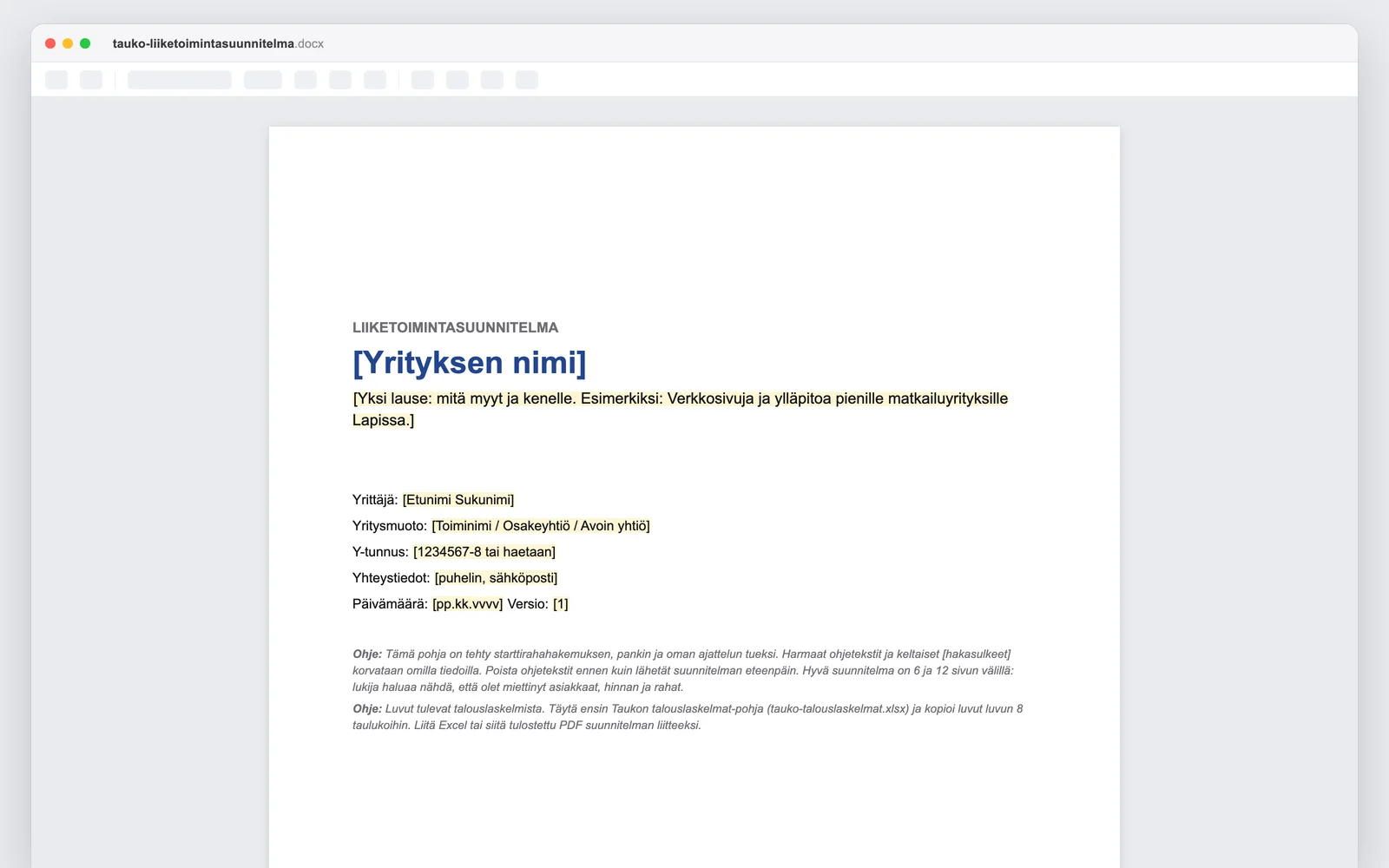
- Ten chapters: summary, entrepreneur, business idea, customers, competitors, marketing and pricing, operations, finances, risks and schedule
- Instruction text under each heading in grey italics, which you delete at the end
- Fields to fill in highlighted in yellow and in square brackets
- Tables for skills, customer groups, competitors, pricing, risks and schedule
- A financial section whose tables match the financing, profitability and sales target calculations in the financial calculations template
- List of attachments for the start-up grant application
How to use the template
- 1Do the calculations first
Download the financial calculations template and fill it in. The calculations reveal whether the idea is profitable before you write pages about it.
- 2Write the outline of the plan
Answer the questions in each heading's instruction text in your own words. A concrete example says more than a general promise of quality.
- 3Transfer the financial figures
Copy the figures from the financial calculations into the tables in chapter 8 and write under each one what the assumptions are based on.
- 4Write the summary last
The summary is what the reader reads first. Write it when the rest of the plan is ready and keep it to half a page at most.
- 5Delete the instructions and save as PDF
Delete the grey instruction texts and empty square brackets, check the spelling and save as PDF. Attach the calculations.
Who reads the business plan?
The employment area granting the start-up grant uses the plan to assess whether the business is profitable and whether you have what it takes. The bank and Finnvera assess whether the company can repay its loans. Both read the summary and the financial figures first and only then the rest of the text.
The most important reader, though, is you. As you write, you'll notice if the price doesn't cover costs, if there are too few customers or if starting up needs more money than you have. It's cheaper to notice these on paper than on your bank statement. You'll find the steps for setting up a company in the articles setting up a sole trader business and setting up a limited company.
What is a company operating plan?
In everyday use, a company operating plan ("toimintasuunnitelma") and a business plan ("liiketoimintasuunnitelma") mean the same thing: a written plan of how the company makes money. Sometimes an operating plan means a narrower one-year plan for an established company: goals, actions, responsible people and budget. This template works for both if you leave out the start-up figures and add the year's goals to the schedule table.
The business model is the core of the plan on one page: who you sell to, what value you create, how you reach customers and where income and costs come from. The business plan expands the model into chapters and calculations. If you're starting from scratch, write the business model first, then the financial calculations, and only then the text of the plan.
What does a good plan contain?
A good plan is 6–12 pages and clearly answers four questions: what you sell, to whom, why the customer buys from you in particular and how the money will last. What convinces the reader is being concrete, not length. A sentence giving the number of tourism businesses in the area and saying three of them have already promised to order says more than a page-long market review. The marketing chapter can be written with the help of a separate marketing plan template.
The financial section carries the whole plan. Chapter 8 of the template is built so that its tables match the sheets of the financial calculations template. When the figures are the same in both, the reader doesn't have to guess where a figure comes from.
What does the start-up grant form ask about the business?
The start-up grant application asks you to describe the business idea, the product or service and its strengths and weaknesses. It then asks how you plan to compete, where the biggest risks are, how you'll prepare for them and what you've already done to get the company started. Chapters 3, 5, 9 and 10 of the template answer exactly these questions.
The form also asks how you plan to handle bookkeeping and whether you need advice on financial planning. Give a concrete answer here: who does the bookkeeping, with what tool and how often you follow the figures. A vague answer raises questions. A clear answer shows you've thought about the day-to-day too.
The most common mistakes
The first mistake is claiming there are no competitors. Every company has competitors, even if the alternative is just doing it yourself or not buying. A claim like that makes the reader doubt the whole plan.
The second mistake is a made-up price. The price must be calculated from costs and target income, not copied from a competitor's price list. Work out your own price with the pricing calculation template and check that it's enough for your sales target.
The third mistake is leaving out risks. An honest risk assessment and a plan for preparing for them show you've thought things through. The most common risks are sales relying on one large customer, falling ill yourself and running out of cash in the first months.
Once the company is set up
Open the plan again after six months and compare it with what actually happened. For that you need up-to-date bookkeeping. At Tauko an accountant helps you read the figures. Advice and questions are included in the price.
Frequently asked questions
Is a business plan compulsory?+
The law doesn't require one, but in practice it's asked for when you apply for the start-up grant, a bank loan or Finnvera financing. The business sections of the start-up grant form can be replaced with a separate business plan.
How long should a business plan be?+
For a small company, between 6 and 12 pages with the calculations attached is usually enough. More important than length is that the figures and the text tell the same story.
What goes into a business plan?+
Summary, the entrepreneur's skills, business idea, customers and market, competitors, marketing and pricing, operational arrangements, financial calculations, risks and schedule. The template has a chapter for each.
Where do you start when setting up a company?+
With the business idea and the calculations. Once you know the price covers your costs and your own pay, choose a business form and file the start-up notification. The steps are in the articles setting up a sole trader business and setting up a limited company.
Can I use the template in Google Docs?+
Yes. Open the file in Google Drive and choose to open it with Google Docs. Headings, highlights and tables are kept.
Where can I get help with writing the plan?+
Enterprise Agencies (Uusyrityskeskus) advise new entrepreneurs free of charge, and many municipalities have their own business services. It's also worth going through the financial calculations with an accountant before sending the application.
Should the plan be updated?+
Yes, it's worth it. Once you're up and running, compare actual sales and costs with the plan and update your assumptions. An updated plan is a good basis when you apply for more financing or hire your first employee.