Profitability calculation: free template, example and financing plan for the start-up grant and the bank
A profitability calculation shows how much a company must sell in a year to cover fixed costs, variable costs, loans, taxes and the entrepreneur's own living. For example, a net income of €30,000, fixed costs of €18,000 and purchases of 20% require turnover of about €76,900 excluding VAT. The start-up grant application and a bank loan application ask the same thing: how much money you need, where it comes from and how much you have to sell. The template's rows follow the sections of the start-up grant form, so you can copy the figures straight into the application.
Free, no sign-up. A standard .xlsx or .docx file.
The template itself is in Finnish, as used in Finland.
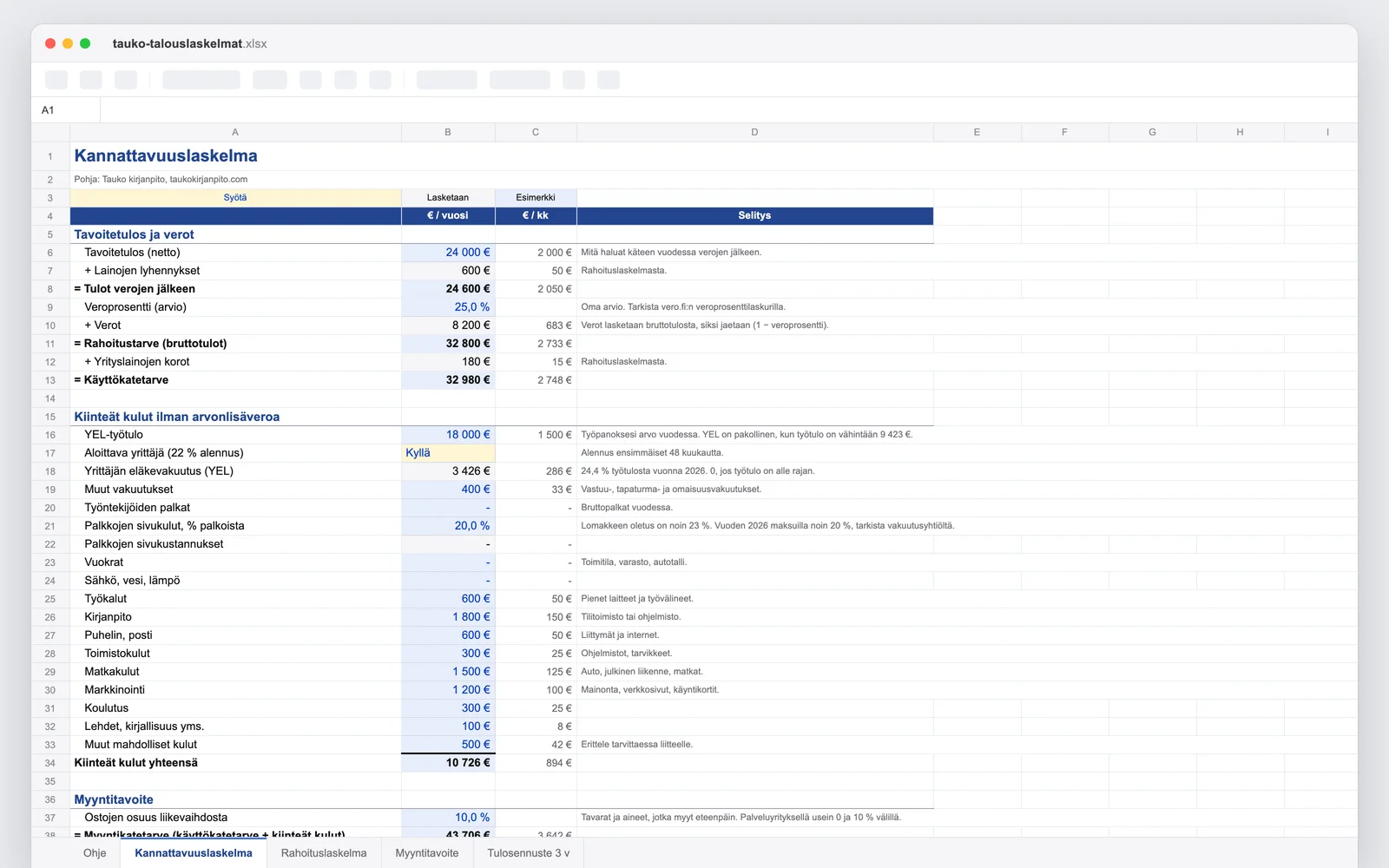
What's in the template
- Profitability calculation in the row order of the start-up grant form: target income, taxes, loans, fixed costs, sales margin and turnover target
- YEL is calculated with the 2026 rate of 24.4%, and the 22% discount for new entrepreneurs is selected from a list
- Financing plan: investments, working capital, start-up costs and a cost overrun reserve, plus sources of financing and the surplus or deficit
- Sales target in months, hours, deals and products, so you can see whether the target is realistic
- Three-year profit forecast with depreciation, interest and loan repayments for the bank
- An instructions sheet explaining what the employment area and the bank expect from the calculations
How to use the template
- 1Start with profitability
Enter how much you want to take home per year and estimate your tax rate and fixed costs. The template calculates how much you need to sell excluding and including VAT.
- 2Work out your financing need
List your investments and estimate how many months of costs you need to cover before sales get going. Enter your sources of financing. The surplus or deficit must be at least zero.
- 3Check the sales target
The Sales target sheet turns the annual figure into hours and deals. If the required hourly rate or number of customers looks impossible, change your price or costs now rather than after you've started.
- 4Enter your growth assumptions
The 3-year forecast sheet uses the figures from the previous sheets. Just enter sales growth and the change in costs for the second and third year.
- 5Attach it to your application
Copy the figures into sections 3 and 4 of the start-up grant form or attach the file as a PDF to your business plan. Agree with the employment area which way suits them.
What is a profitability calculation?
A profitability calculation is a financial calculation that shows how much sales a company needs to cover all its costs and give the entrepreneur the income they're aiming for. It is usually done at annual level and excluding VAT. The calculation works backwards from the goal: first you decide how much the entrepreneur needs to take home, then you add taxes, loan repayments, interest, fixed costs and purchases.
A profitability calculation is usually made when starting a company, applying for the start-up grant or a bank loan, or planning an investment or a price increase. In an established company the same thinking is used in the budget, which has its own budget and cash flow template. The equivalent calculated from actual sales is the contribution margin calculation.
A profitability calculation is not the same as a financing plan or a cash flow calculation. The financing plan shows how much money getting started takes and where it comes from. The cash flow calculation shows whether the money lasts month by month. The profitability calculation shows whether the business pays off over a year.
Profitability calculation template as text: copy the rows
If you don't want to use Excel, do the profitability calculation on paper or in your notes using these rows. Enter annual figures excluding VAT and calculate from top to bottom. The Excel template and the profitability calculation in the start-up grant application use the same row order.
1. Target net income (take-home) ____ € · 2. + Taxes ____ € · 3. + Loan repayments ____ € · = Required financing income ____ €
4. + Interest ____ € · 5. + Total fixed costs ____ € (YEL, premises, car, phone and software, bookkeeping, insurance, marketing, other) · = Sales margin target ____ €
6. Variable costs, i.e. purchases ____ % of turnover · Turnover target = sales margin target / (1 − purchase share) = ____ € · + VAT 25.5% or 13.5% = sales including VAT ____ €
7. Monthly sales target = turnover target / sales months ____ € · Required hourly rate = turnover target / billable hours per year ____ €/h · or number of deals = turnover target / average purchase ____ pcs
Once the rows are filled in, compare the hourly rate or number of deals with what is realistic to sell in your field. The YEL calculator helps with the fixed cost breakdown and the hourly rate calculator with checking the hourly rate. A worked example using the same rows follows in the next section.
Profitability calculation example, line by line
A worked example of a sole trader. All figures are per year and excluding VAT. The rows are in the same order as in the start-up grant application's profitability calculation.
1. Target net income (take-home) €30,000. 2. + Taxes, estimated at 25%: €10,000 (gross income €40,000). 3. + Loan repayments €3,000. = Required financing income €43,000.
4. + Interest €500. 5. + Fixed costs €18,000: YEL €7,320 (earned income of about €30,000, 24.4%, without the new entrepreneur discount), premises €4,800, car €2,400, phone and software €1,200, bookkeeping €1,100, insurance €700 and marketing €480. = Sales margin target €61,500.
6. + Variable costs, i.e. purchases, 20% of turnover. Turnover = 61,500 / (1 − 0.20) = €76,875 excluding VAT, of which purchases are €15,375. With VAT at 25.5% added, sales are €96,478 a year.
7. The sales target in everyday figures: with 11 sales months you need sales of €6,989 a month excluding VAT. With 5 billable hours a day for 46 weeks (1,150 hours), the hourly rate must be at least €66.85 excluding VAT.
If the hourly rate seems too high, change your assumptions now: cut fixed costs, add billable hours or review your target income. You can check the same figures with the hourly rate calculator and the YEL calculator.
Investment profitability calculation
An investment profitability calculation shows whether a single purchase, such as a machine, car or software, pays for itself. The simplest measure is the payback period: the price of the investment divided by the net cash it adds or saves each year.
A worked example: a €12,000 machine brings in €4,500 more margin a year, and running it costs €500 a year. The net benefit is €4,000, so the payback period is 12,000 / 4,000 = 3 years. If the machine's useful life is five years and you require a 5% return on your money, the present value of the net benefits is 4,000 × 4.3295 = €17,318, and the investment is €5,318 profitable.
You can calculate depreciation of the investment for bookkeeping and taxation with the depreciation calculator.
What calculations does the start-up grant application need?
The start-up grant is applied for from the employment services of your own municipality or employment area, because the TE Services moved to municipal employment areas at the start of 2025. The application form has two calculation sections: 3. Financing plan and 4. Profitability calculation. According to the form's instructions, they can be replaced with a separate business plan and calculations.
As attachments, the form lists the business plan and the financing, sales and profitability calculations, a tax debt certificate and an account of how the financing is arranged, such as a loan commitment from the bank. This template's profitability calculation follows the same order as the form. The conditions for the start-up grant are explained in the article start-up grant.
How to read a profitability calculation
A profitability calculation is read from the end to the beginning. First you decide how much you want to take home and add loan repayments and taxes to that. This gives you your financing need. When you add interest and fixed costs, you get the sales margin you have to reach. When purchases are added on top, you get the turnover you need.
In the template's example, a net target of €24,000, fixed costs of €10,726 and purchases of 10% require turnover of about €48,600 a year. With 11 sales months that is about €4,400 a month, and with five billable hours a day for 46 weeks, the hourly rate comes to about €42 excluding VAT. You can compare the result with the figure from the hourly rate calculator.
The most common mistakes in the calculations
The first mistake is leaving out YEL or calculating it wrong, even though it is often the largest single fixed cost. The template calculates the YEL contribution from earned income and takes the new entrepreneur discount into account. If earned income is below €9,423, YEL is not compulsory. In that case, however, no pension accrues, and your social security is not based on earned income.
The second mistake is estimating sales for 12 months and eight billable hours every day. Holidays, illness and getting sales started take months, and selling, invoicing and admin take part of every day. A calculation that ignores this won't convince the reader.
The third mistake is recording the start-up grant as company financing. The start-up grant is personal income that secures your living. It does not belong among the sources of financing in the financing plan.
Once the calculations are done
The calculations are an estimate, and the first year teaches you the most. Once you're up and running, compare actual figures with the calculation every month so you can react to deviations in time. At Tauko you can ask an accountant whenever you need to, and advice is included in the fixed monthly price.
Once you know your turnover target, you can also see what bookkeeping costs for a company of your size: see your price. If your company already has an accounting firm, you can get competing quotes in a minute and use the savings to reduce your fixed costs.
Frequently asked questions
What is a profitability calculation?+
A profitability calculation shows how much a company must sell in a year to cover fixed and variable costs, loans, taxes and the entrepreneur's own living. It is done excluding VAT and calculated backwards from the target income.
How do you make a profitability calculation?+
Start with your target net income and add taxes and loan repayments. Add interest and fixed costs to get your sales margin target. Divide it by (1 − purchases as a share of sales) to get the turnover you need. Finally, turn the turnover into monthly, hourly or unit figures.
What's the difference between a profitability calculation and a financing plan?+
The financing plan shows how much money starting the company takes and where the money comes from. The profitability calculation shows how much you need to sell in a year to cover costs, taxes, loans and your own living. The start-up grant application asks for both.
What is a sales target calculation?+
It turns the turnover in the profitability calculation into everyday figures: sales per month, billable hours, deals or products. It shows whether the target is achievable with your working hours and prices.
Where do you apply for the start-up grant in 2026?+
From the employment services of your own municipality or employment area, because the TE Services moved to municipal employment areas on 1 January 2025. The application is made before you start the business, and the calculations can be attached to the application or filled in on the form.
Are the calculations done excluding VAT?+
Yes. All costs and turnover are calculated excluding VAT, and VAT is only added to total sales. The profitability calculation on the start-up grant form works the same way.
What is a suitable target income?+
The amount you can live on after taxes: housing, food, loans and savings. Don't reduce it to make the calculation look easier. A target that is too low means the company won't support you, even if the calculation looks good.
Is the template suitable for a bank loan application?+
Yes, as a basis. The bank usually wants to see a financing plan, profitability and a forecast for a few years, and the template has all of them. Ask the bank whether anything else is needed, such as an account of collateral.