Pricing calculation: free Excel template for working out your hourly rate and product price
A pricing calculation shows the minimum your price must be to earn your target salary and cover the company's costs. This free template calculates your hourly rate from your target salary, the YEL contribution, your costs and how many hours you can really bill. For products, it calculates the selling price based on margin and tells you how many units you need to sell to cover fixed costs.
Free, no sign-up. A standard .xlsx or .docx file.
The template itself is in Finnish, as used in Finland.
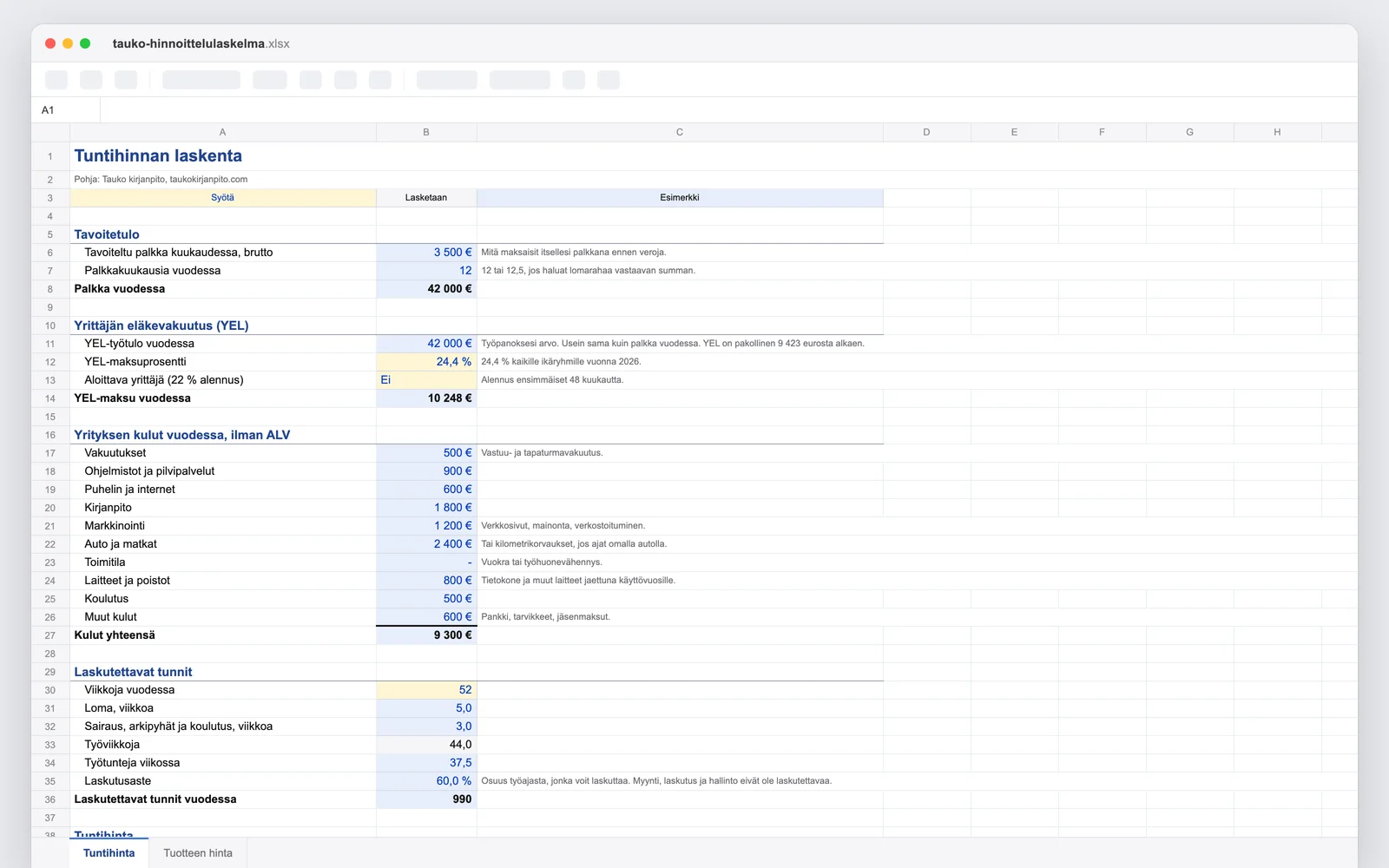
What's in the template
- Hourly rate from target salary: annual salary, YEL 24.4% and the 22% discount for new entrepreneurs, company costs and profit margin
- Billable hours: holidays, illness and public holidays, plus utilisation rate, i.e. the share of working time you get paid for
- Hourly rate excluding VAT, rounded up to the next five euros, including VAT and as a day rate
- Product price for 15 products: purchase price, other variable costs, target margin, selling price and markup
- Break-even sales volume: how many units a month cover fixed costs
- Example figures that you overwrite with your own
How to use the template
- 1Decide your target salary
Enter what you would pay yourself as a monthly salary before taxes. The calculation starts from that, not from whatever happens to be left over.
- 2Check your YEL earned income
YEL earned income is often the same as your annual salary. The contribution is 24.4%, and new entrepreneurs get a 22% discount for 48 months.
- 3List your costs
Enter the company's annual costs excluding VAT: insurance, software, phone, bookkeeping, marketing, car and equipment.
- 4Estimate your billable hours honestly
Deduct holidays, illness and public holidays and estimate how much of your working time you can bill. In the template's example it's 60% of a 37.5-hour week.
- 5Read your hourly rate and compare it with the market
The template shows the lowest price at which your target is met. If it's clearly above the market rate, cut costs or raise your utilisation rate before lowering your target salary.
Why is the hourly rate usually too low?
New entrepreneurs often compare their hourly rate with their old salary. A monthly salary of €3,500 is about €22 an hour, so an hourly rate of €40 feels fair. But an entrepreneur pays for their own pension, holidays, sick days and equipment, as well as all the hours that can't be billed.
In the template's example, the same €3,500 target salary, YEL without the discount, costs of €9,300 and a 10% profit margin require turnover of about €68,400. There are 990 billable hours a year, so the hourly rate comes to €70 excluding VAT and €87.85 including VAT. You get the same result with the hourly rate calculator.
Margin and markup: the most common pricing mistake
Margin is calculated from the selling price and markup from the purchase price. If you buy a product for €60 and add 40% to it, the selling price is €84, but the margin is only 28.6%. If your goal was a 40% margin, the selling price must be €100.
The Product price sheet always calculates the selling price from the target margin and shows the corresponding markup next to it. It also includes packaging, delivery and payment processing costs, which are easy to forget. You can check a single price with the margin calculator.
The bottom of the sheet tells you whether the margin covers fixed costs. The template divides the monthly fixed costs by the average margin. The result is the break-even sales volume, i.e. the number of units you must sell before anything is left for you. If the figure is more than you can produce or sell, your price is too low.
VAT and price: who is shown what?
Business customers are usually quoted the price excluding VAT, because the company deducts the VAT. Consumers must be shown a price that includes all taxes. The template shows both. The standard rate is 25.5%, and for example passenger transport, accommodation and sports services are 13.5%.
If your turnover is below €20,000 in a calendar year, you don't have to register for VAT. In that case the price is the same for everyone, but you can't deduct VAT on purchases. The threshold applies to both the current and the previous calendar year.
Once the price is calculated
Check your price at least once a year and whenever your costs change: the YEL discount ends, rent goes up or the price of bookkeeping changes. Many entrepreneurs only notice in the financial statements that the price wasn't enough. At Tauko you can go through your pricing with an accountant, and questions are included in the price.
Frequently asked questions
How is the hourly rate calculated?+
Add up your annual target salary, the YEL contribution and the company's costs, add a profit margin and divide the total by your billable hours. There are clearly fewer billable hours than working hours, because selling, invoicing and admin are not billable work.
What is a good utilisation rate?+
It depends on the field and how much time goes into sales. In the template's example it's 60%. Log your hours for a month and you'll know your own figure instead of guessing.
Do I need to add VAT to the price?+
If you're registered for VAT, yes. The standard rate is 25.5%. Business customers are usually quoted the price excluding VAT and consumers the price including VAT.
What's the difference between margin and markup?+
Margin is the difference between the selling price and the purchase price as a percentage of the selling price. Markup is the same difference as a percentage of the purchase price. A 40% margin corresponds to a markup of about 66.7%.
Is the template suitable for a limited company?+
Yes. Enter as your target salary the salary the company pays you, and add employer contributions on salary to the company's costs. If you're YEL-insured in a limited company, the YEL calculation works as it is.
How often should I raise my prices?+
Check your price once a year and whenever your costs change. Small annual increases are easier for a customer to accept than a big increase every few years.