Inventory list template (Excel): stocktake and valuation on 31 December
An inventory list is a list of your stock on the last day of the financial year, and with this free template you make it in Excel. You enter the product, quantity, unit and purchase price, and the template calculates the acquisition cost, the lowest value, the balance sheet value and any write-down. Obsolete products are marked with their own option, and the summary shows how much the inventory changed for the income statement.
Free, no sign-up. A standard .xlsx or .docx file.
The template itself is in Finnish, as used in Finland.
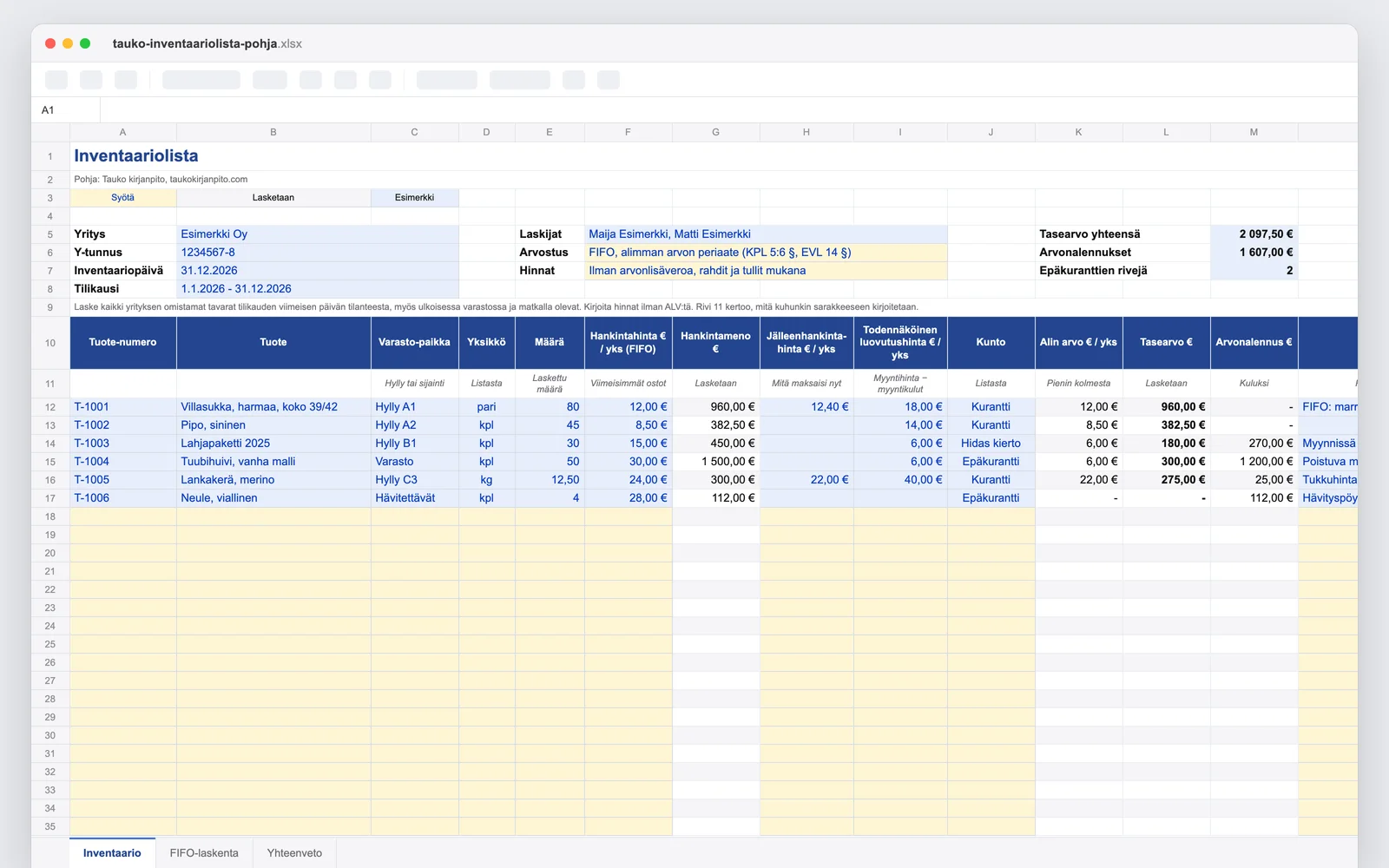
What's in the template
- Inventory tab for 200 products: product number, product, storage location, unit, quantity and purchase price excluding VAT
- Lowest value formula: the smallest of purchase price, replacement price and probable selling price, and the write-down in euros
- Condition options Current, Slow-moving or Obsolete. An obsolete row turns red, and without a selling price its value is €0
- FIFO calculation from purchase batches: when the same product was bought at different prices, the template calculates the price of the units left in stock, plus the average price for comparison
- Summary: acquisition cost, write-downs and balance sheet value, a breakdown by condition and the change in inventory for the income statement
- Fields for the count date, the counters and a signature, so the list works as an attachment to the balance sheet specifications
How to use the template
- 1Fill in your company details
Enter the company, Business ID, inventory date and counters. If your financial year is the calendar year, the inventory date is 31 December.
- 2Count one shelf at a time
Enter each product on its own row: quantity, and unit from the list. Also count goods in external storage and goods in transit that you own.
- 3Price on a FIFO basis
Enter as the purchase price the price of the most recent purchases excluding VAT, including freight and customs duties. If the same product was bought at different prices, calculate the price on the FIFO calculation tab.
- 4Mark lower values and obsolete items
If the product could now be bought more cheaply or is sold below purchase price, enter the replacement or selling price. For broken and outdated items, choose Obsolete as the condition and write the reason in the notes.
- 5Check the summary and sign
The summary shows the balance sheet value of the inventory and the change from the previous year. Print the list, date and sign it, and give it to your accountant for the financial statements.
What must an inventory list include?
An inventory list is the document that verifies the value of the inventory in the financial statements. It must show the products, quantities, unit prices, valuation basis, total, count date and counters. The list is part of the balance sheet specifications, which are kept for at least 10 years from the end of the financial year.
The count reflects the situation on the last day of the financial year. If you can't count exactly on 31 December, count a few days before or after and adjust for purchases and sales in between. Write the adjustments in the notes column so they can still be seen later. The whole inventory process is described in the article inventory in bookkeeping.
How the template values the inventory
Inventory is valued at acquisition cost: the purchase price excluding deductible VAT, plus freight, customs duties and other variable costs of acquisition. If the replacement price, meaning what buying the product would cost now, or the probable selling price is lower, the lowest is used. This is the lower-of-cost principle in chapter 5, section 6 of the Finnish Accounting Act and section 14 of the Business Income Tax Act.
Probable selling price means the sales price minus selling costs, such as discounts and delivery costs. For example, 50 tube scarves with a purchase price of €30 that are sold off at €6 are entered in the balance sheet at €300. The write-down of €1,200 is recorded as an expense.
For tax purposes the default is FIFO: the items bought first are treated as sold first, so the most recently bought remain in stock. If you bought 100 units at €10 in September and 100 units at €12 in November and there are 80 on the shelf, their FIFO price is €12 and their value €960. At average price the value would be €880. The FIFO calculation tab does this from the purchase batches.
Obsolete products
An obsolete product is one that can't be sold at the normal price: broken, outdated, out of season or unsold for a long time. In the template it is marked with the Condition option, and the row shows in red. If you enter a selling price, the product is valued at that. If you don't, its value is €0 and the whole acquisition cost is recorded as an expense.
You must be able to justify a lower value. Write the reason in the notes, for example a clearance price, a supplier's price list or a photo of the damage. Separate disposal records are made for destroyed products. Use the same valuation basis every year, not whichever gives the lower profit.
Free inventory accounting: is Excel enough?
Inventory accounting means continuous tracking: every arrival and sale is recorded, and the balance is always up to date. An inventory list is a different thing. It is a once-a-year count that verifies the value of the inventory in the financial statements. A small business often manages with the stocktake alone when it has few products and purchases are expensed directly.
You can also use this template as free inventory accounting: copy the Inventory tab every month, update the quantities and compare the balances. When you have hundreds of products or sell online, continuous inventory accounting is best handled with the stock feature of your online shop or till system, and the stocktake is still done at year end.
Change in inventory for the income statement
During the year, purchases are usually expensed directly. In the financial statements, expenses are adjusted by the change in inventory: opening inventory is added to expenses and closing inventory is deducted. The Summary tab calculates the change when you enter the previous year's closing inventory. An increase in inventory reduces expenses and increases profit, so uncounted inventory distorts taxes in two years.
At Tauko you can ask your accountant about the inventory list, valuation and recording obsolete items, and the advice is included in the price. Financial statements are invoiced separately. The whole of the financial statements is described in the article financial statements in a small business.
Frequently asked questions
What is an inventory list?+
A list of the company's stock on the last day of the financial year: products, quantities, unit prices and value. It is the document that verifies the value of the inventory in the financial statements.
Is inventory counted with or without VAT?+
Without, if the company is VAT-registered and can deduct the VAT on purchases. Freight, customs duties and other variable costs of acquisition are part of the acquisition cost.
What is the lower-of-cost principle?+
Inventory is entered in the balance sheet at acquisition cost or at a lower replacement price or probable selling price. The template picks the smallest of the three and calculates the difference as a write-down.
How is the FIFO price calculated?+
The most recently bought products are treated as remaining in stock. On the FIFO calculation tab, enter the purchase batches from newest to oldest and the quantity in stock, and the template calculates the price of what is left.
How is an obsolete product marked?+
Choose Obsolete as the condition and enter the probable selling price if the product can still be sold. Without a selling price the value is €0. Write the reason in the notes.
How long must the inventory list be kept?+
The inventory list is part of the balance sheet specifications, which under the Finnish Accounting Act are kept for at least 10 years from the end of the financial year.
Is an inventory list the same as inventory accounting?+
No. Inventory accounting tracks the balance continuously; an inventory list counts the stock once at the end of the financial year. A stocktake is needed for the financial statements in any case, even without continuous inventory accounting.
Does the template work in Google Sheets and Numbers?+
Yes. The template uses only common functions such as SUM, MIN, IF, SUMIF and SUMPRODUCT, and the drop-down lists work in all three.