Travel expense claim template: per diems and kilometres in Excel 2026
The travel expense claim template is an Excel file that calculates the per diem from the length of the trip and the mileage allowance from the kilometres driven. It also brings receipt expenses into the same calculation. The 2026 tax-free maximum amounts are ready, and you can update them in one place.
Free, no sign-up. A standard .xlsx or .docx file.
The template itself is in Finnish, as used in Finland.
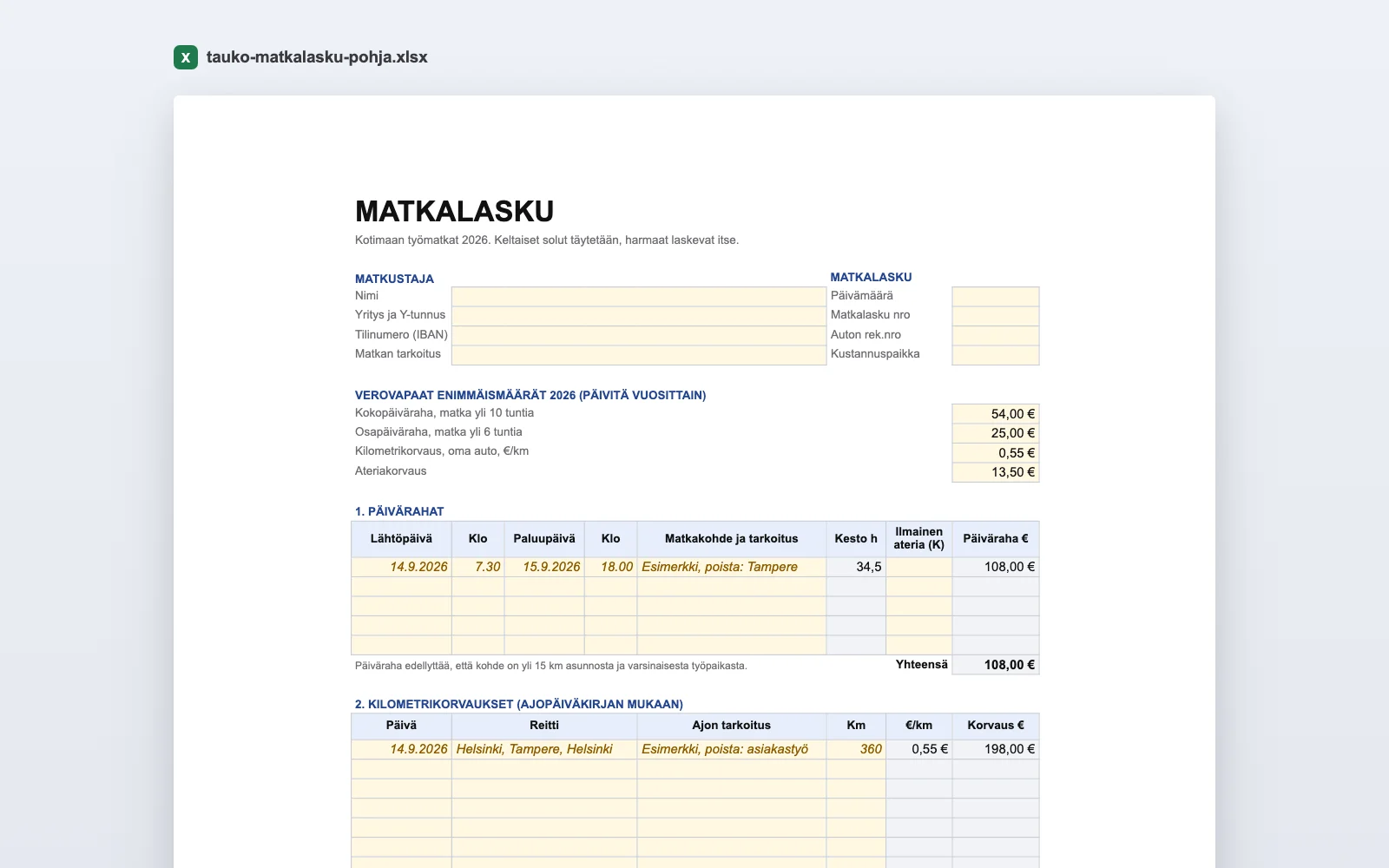
What's in the template
- Per diems that the template calculates from departure and return times: full per diem €54 and partial per diem €25
- Rule for trips of several days: full 24-hour periods and extra hours
- Halving for free meals with a single entry
- Mileage allowance €0.55/km and meal allowance €13.50
- Other travel costs as per receipts: train, hotel, parking
- Summary and signature fields on one A4 page
How to use the template
- 1Fill in your own details
Name, company, bank account number and purpose of the trip. The purpose is the most important detail, because it shows the trip was a business trip.
- 2Record departure and return precisely
Delete the example lines. Enter the departure date and time and the return date and time. The template calculates the duration and the per diem.
- 3Mark free meals
If you got two free meals on a full day or one on a partial day, enter K. The per diem is halved. On a trip of several days, put the meal day on its own line.
- 4Add kilometres from your driving log
Enter the route, purpose and kilometres. It's best to take the kilometres straight from your driving log.
- 5Attach receipts and sign
Record train and hotel costs as per the receipts, attach the receipts and sign. The travel expense claim is a document that is kept in the books.
How much per diem can you get in 2026?
Under the Finnish Tax Administration's decision, the domestic full per diem is €54 and the partial per diem €25 in 2026. The partial per diem is paid when a trip lasts more than 6 hours, and the full per diem when it lasts more than 10 hours. The destination must also be more than 15 kilometres from the starting point (home or regular workplace) and more than 5 kilometres from both.
When a trip lasts more than 24 hours, a full per diem is paid for each full 24-hour period. For the extra hours, a partial per diem is paid if there are more than 2, and a full per diem if there are more than 6. In the template's example, a 34.5-hour trip is one 24-hour period and 10.5 hours. That gives two full per diems, €108 in total.
A free meal halves the per diem: two meals for a full per diem, one for a partial per diem. You can check a single trip with the per diem calculator.
Mileage allowance and meal allowance
When you drive on a business trip in your own car, the tax-free mileage allowance is €0.55 per kilometre in 2026. To claim it you need a driving log showing the date, route, purpose and kilometres. Without it the allowance is not accepted as tax-free.
The meal allowance of €13.50 can be paid for days on which no per diem is paid, when the work is done at a temporary workplace and you can't get to your usual place to eat. Both are not paid for the same day.
Example: a two-day customer trip
You leave Helsinki for Tampere on Monday at 7:30 and return on Tuesday at 18:00. The trip lasts 34.5 hours, so you earn two full per diems, €108. You drove 360 kilometres in your own car, so the mileage allowance is €198. The hotel receipt goes under other travel costs. Without the hotel, the claim totals €306, the same as the total of the template's example lines.
If the customer bought you lunch and dinner on Tuesday, the halving applies only to Tuesday's per diem. In that case split the trip over two lines: from Monday 7:30 to Tuesday 7:30, and from Tuesday 7:30 to 18:00, and enter K only on the second. The per diems are €54 and €27.
Who is a travel expense claim made for?
For an employee, a travel expense claim is a request for the employer to reimburse travel costs tax-free. A shareholder of a limited company can receive tax-free allowances from the company at the same rates as other employees, as long as the trips are documented. A sole trader records per diems and mileage allowances as business expenses, and the travel expense claim is the document for the entry.
The most common mistake is doing travel expense claims once a year from memory. Then the times and kilometres are estimates, and estimates are hard to defend in a tax audit. Another mistake is claiming a per diem for a trip that doesn't meet the 15-kilometre limit, or forgetting to halve it for free meals.
Trips without Excel
You don't need to calculate per diems and mileage allowances by hand. The main thing is to record the details right after the trip, while the times and kilometres are still fresh.
The Excel template works well if you make a few trips a month. If you travel a lot or the per diem conditions are unclear, you can ask your accountant at Tauko. Advice is included in the price. Read more about per diems.
Frequently asked questions
What is the per diem in 2026?+
The domestic full per diem is €54 and the partial per diem €25 in 2026. The meal allowance is €13.50 and the mileage allowance for your own car €0.55 per kilometre.
What must a travel expense claim contain?+
The traveller's name, the purpose of the trip, departure and return times, the destination, kilometres driven with routes, and receipts for other costs. A date and signature make it a bookkeeping document.
How long must a trip be to qualify for a per diem?+
The trip must last more than 6 hours, and the destination must be more than 15 kilometres from the starting point (home or regular workplace) and more than 5 kilometres from both. A full per diem requires a trip of more than 10 hours.
Can a sole trader get a per diem?+
A sole trader doesn't pay themselves a salary, but can record per diems and mileage allowances as business expenses when the trips are documented. The travel expense claim and the driving log are the supporting documents.
What happens if I get a free lunch?+
If you get two free meals on a full-day trip, the per diem is halved to €27. On a partial-day trip, one free meal halves the partial per diem to €12.50.
How long are travel expense claims kept?+
Travel expense claims are bookkeeping documents and are kept for six years from the end of the year in which the financial year ended.