Driving log template: free Excel that meets the Finnish Tax Administration's requirements
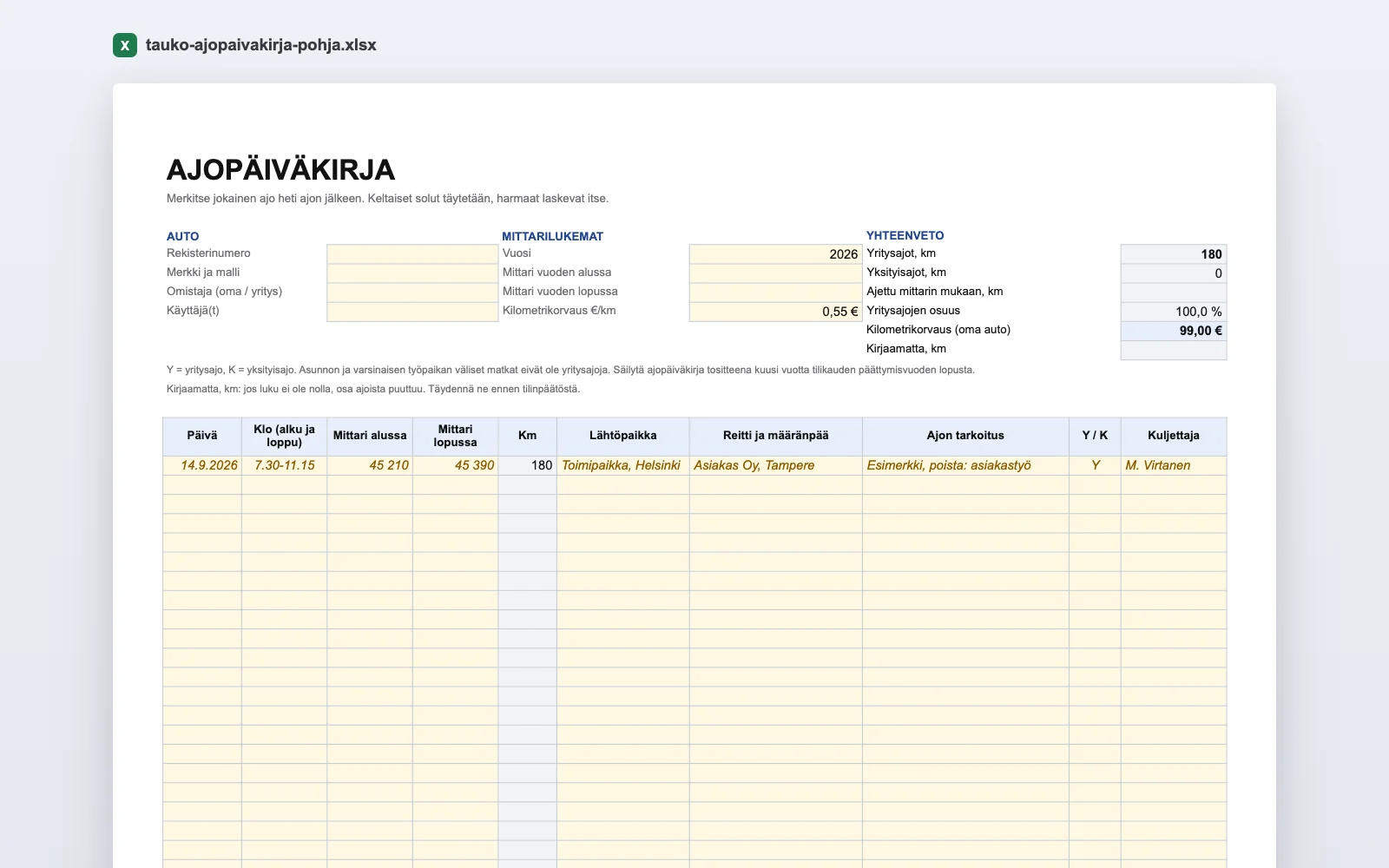
The driving log template is an Excel file with every detail the Finnish Tax Administration requires for business trips. When you enter the odometer readings, the template calculates the kilometres, separates business and private trips and shows the mileage allowance and a monthly summary.
Free, no sign-up. A standard .xlsx or .docx file.
The template itself is in Finnish, as used in Finland.
What's in the template
- Columns for all the required details: date and time, odometer readings, starting point, route and destination, purpose and driver
- Kilometres are calculated from the odometer readings, and a wrong reading is flagged for checking
- Business and private trips are separated by choosing Y or K
- Summary: share of business driving and mileage allowance €0.55/km
- Unrecorded kilometres show up from the odometer readings at the start and end of the year
- A tab for each month and 300 trip lines; also prints as a paper form
How to use the template
- 1Fill in the car details
Registration number, make, owner and users. Write down the odometer reading at the start of the year right away in January.
- 2Record each trip straight away
Delete the example line. Enter the date, times and odometer reading at the start and end of the trip. The template calculates the kilometres.
- 3Give the route and purpose
Enter the starting point, route and destination, and the purpose so that an outsider understands it: for example the customer's name and what was done there.
- 4Mark Y or K
Y ("yritysajo") is a business trip and K ("kotiajo") a private trip. Record private trips too if the car is in the company's name.
- 5Check at the end of the year
Enter the odometer reading at the end of the year. If "Kirjaamatta, km" (unrecorded km) is not zero, fill in the missing trips before the financial statements.
What must be recorded in a driving log?
According to the Finnish Tax Administration's guidance, for business trips you record the start and end time of the trip, the starting point and destination and, if needed, the route, the length of the trip, its purpose, the odometer reading at the start and end, and the driver. You also need the total kilometres driven in the car during the year, which you get from the odometer readings at the start and end of the year.
The format is not prescribed. A notebook, Excel or an app are all fine, as long as the details are recorded at the time of driving rather than estimated afterwards. The requirements are covered in more detail in the article driving log.
Just "customer visit" is not enough as a purpose. Write whom you visited and what you did, for example "Asiakas Oy, measuring for kitchen renovation".
Why keep a driving log?
For business trips in your own car you can deduct a mileage allowance, which is €0.55 per kilometre in 2026. Just 5,000 business kilometres a year means an expense of €2,750. Without a driving log the deduction is not accepted.
If the car is in the company's name, the driving log proves the opposite: how much the car has been driven privately. Without it, the share of private use is estimated, and the estimate is rarely in the entrepreneur's favour. The template's summary calculates the share of business driving for you.
Example: the year's summary
The odometer showed 45,000 kilometres in January and 63,000 in December, so the car has been driven 18,000 kilometres. The log records 9,000 kilometres of business trips and 8,200 kilometres of private trips. "Kirjaamatta, km" (unrecorded km) then shows 800. Those trips are missing and must be filled in before any figures are calculated.
Once the missing trips have been filled in as private trips, the template calculates the share of business driving as 50% and the mileage allowance for your own car as 9,000 x 0.55 = €4,950. The same share is needed if the car is in the company's name and private use has to be separated from expenses.
Most common mistakes in a driving log
A driving log made afterwards is the most common problem. Trips written up at the end of the year from a calendar show up as round numbers, and the odometer readings don't match the service receipts. Record each trip on the same day.
Another mistake is recording trips between home and your regular workplace as business trips. They are commuting trips and are deducted differently. A third mistake is forgetting private trips. The template's "Kirjaamatta, km" (unrecorded km) field shows if the odometer has more kilometres than the log.
Driving log on your phone
Excel works if you remember to open it. Many entrepreneurs forget, and in January they face a whole year of catching up. If you use Excel, save the file to the cloud and open it on your phone at the end of each trip. Two minutes a day is less than two days in January.
Your accountant sees the same details and asks if something looks odd, before it becomes a problem in your taxation. You can quickly calculate the allowance for a single trip with the mileage allowance calculator.
Frequently asked questions
What is recorded in a driving log?+
For each trip: the date and time, odometer reading at the start and end, starting point and destination, the route if needed, the purpose of the trip and the driver. You also need the odometer readings at the start and end of the year.
Is Excel acceptable as a driving log?+
Yes. The Finnish Tax Administration doesn't prescribe the format, as long as the required details are included and recorded at the time of driving. Don't change old lines afterwards.
Do private trips have to be recorded?+
If the car is in the company's name, yes, because the driving log shows the amount of private use. For your own car, the log records business trips, but you still need the total kilometres for the year.
How much is the mileage allowance in 2026?+
The tax-free mileage allowance for your own car is €0.55 per kilometre in 2026. In the template the rate is in its own cell, so you can update it when the year changes.
How long is a driving log kept?+
A driving log is a bookkeeping document and is kept for six years from the end of the year in which the financial year ended.
What if I forgot to record trips?+
Fill them in right away using your calendar, invoices and fuel receipts, and mark the line as a later addition. The closer to the trip the entry is made, the better it stands up to an audit.