Expense claim template: expenses paid with your own money and VAT in Excel
The expense claim template is an Excel file for collecting business expenses you paid with your own card or in cash. That way the expenses end up in the books and the money back in your account. The template separates the VAT on the receipt, calculates the amount excluding VAT and groups the expenses by type.
Free, no sign-up. A standard .xlsx or .docx file.
The template itself is in Finnish, as used in Finland.
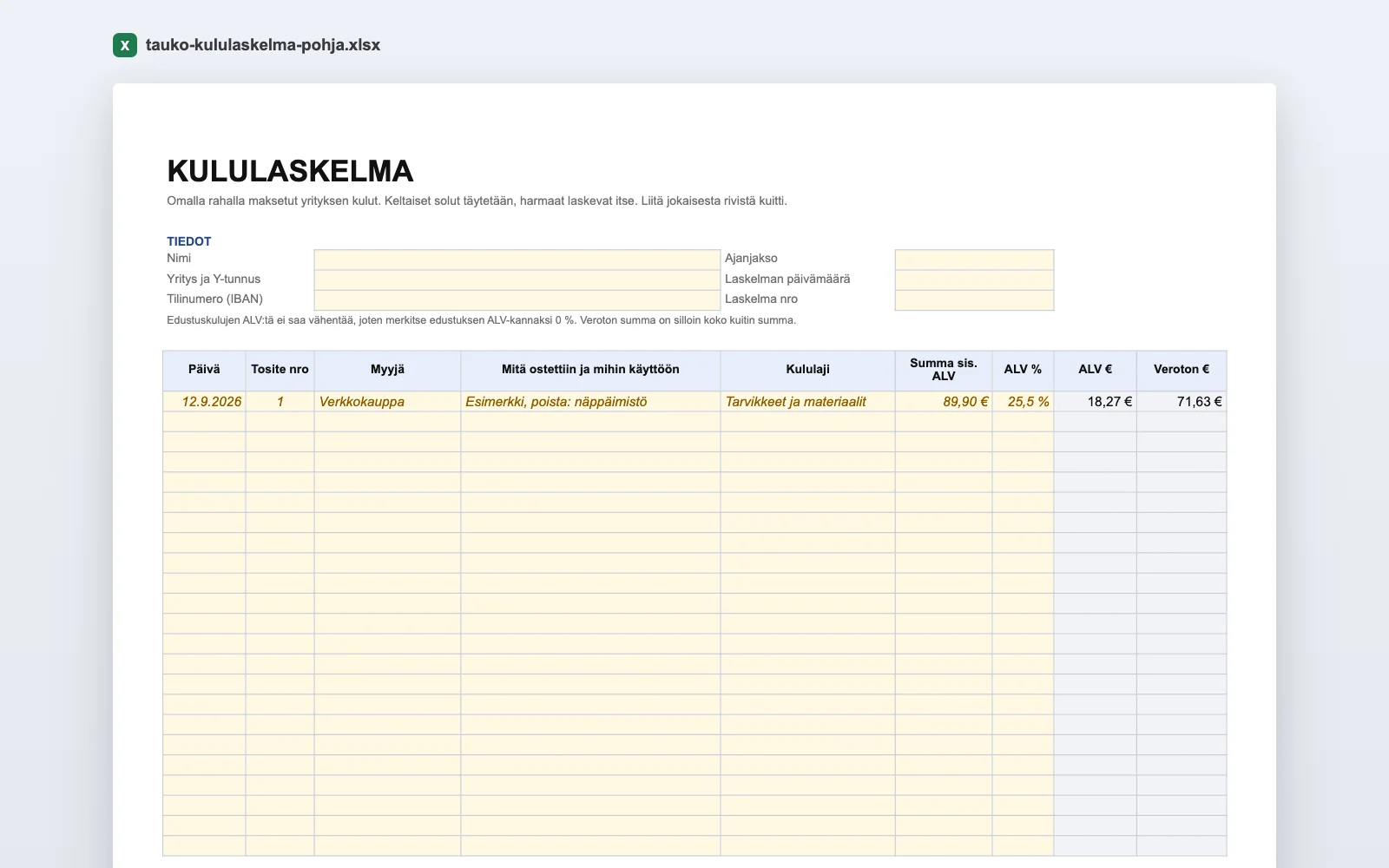
What's in the template
- A line for each receipt: date, document number, seller, purpose and expense type
- VAT is calculated from the receipt's amount including VAT at the selected rate
- Summary for ten expense types, such as supplies, software, travel and entertainment
- VAT breakdown by rate for the VAT return
- A check that shows lines without an expense type
- Amount payable and approval with signatures
How to use the template
- 1Collect your receipts
Get out all the receipts you paid with your own money and number them in sequence. The same number is written on the receipt and in the template.
- 2Enter each receipt on a line
Delete the example line. Enter the date, the seller, what you bought and what for, the amount including VAT and the VAT rate.
- 3Choose the expense type
The expense type is chosen from a list. The summary adds up the totals, so you see straight away where the money went.
- 4Check entertainment and private purchases
Set the VAT rate for entertainment expenses to 0%, because VAT on entertainment can't be deducted. Private purchases are not recorded at all.
- 5Approve and pay
Sign the claim, attach the receipts and pay the amount from the company's account to your own account. The claim and the receipts are the document for the entry.
What is an expense claim and who needs one?
An expense claim is a summary of expenses you paid yourself but that belong to the business. In a limited company it lets you get the money back from the company tax-free, because the company reimburses an actual expense rather than paying a salary. For a sole trader it gets expenses paid with your own money into the books, so they reduce taxable profit.
Make the claim every month. Then the receipts are still safe, the VAT makes it into the right month's return, and you don't have to hunt for faded thermal-paper receipts at the end of the year.
In a limited company, the amount is paid from the company's account to the shareholder's account. For a sole trader, an expense paid with your own money is recorded as an owner's contribution, and you can transfer the same amount from the business account to yourself as a private withdrawal if you wish.
How is the VAT on a receipt calculated?
A receipt usually shows the amount including VAT. VAT is calculated from it with the formula amount x VAT rate / (1 + VAT rate). In the template's example, a keyboard costing €89.90 contains €18.27 VAT at the 25.5% rate, and the price excluding VAT is €71.63.
A VAT-registered business deducts the VAT in its VAT return and records the amount excluding VAT as an expense. If your business is not liable for VAT, the whole amount is an expense and no VAT is deducted. You can check the calculation with the VAT calculator.
Example: a month's expense claim
In September you paid with your own card for a keyboard at €89.90, a trade book at €35.00 and a customer lunch at €60.00. The VAT on the keyboard at the 25.5% rate is €18.27. The book's rate is 13.5%, so the VAT is €4.16. The lunch is entertainment, so its rate is entered as 0%.
The company pays you €184.90 in total. Deductible VAT is €22.43, and €162.47 is recorded as an expense. Half of the €60 lunch is deducted in income taxation.
Which expenses qualify and which don't?
What qualifies as an expense is what was acquired to earn income: tools, software, trade literature, business travel and marketing. If a purchase is partly private, like a phone you also use in your free time, record only the business share. A machine or device costing more than €1,200 is usually recorded as depreciation rather than as an expense all at once.
Entertainment expenses have two exceptions: their VAT can't be deducted, and only half of them is deductible in income taxation. That's why you enter VAT 0% for entertainment. Read more about entertainment expenses and small acquisitions.
Most common mistakes and how to save time
The most common mistake is a receipt that doesn't show what was bought or why. Always write the purpose on the line, and for entertainment also who was hosted. Another mistake is deducting VAT from a receipt where the VAT isn't itemised. A third is letting receipts pile up until the end of the year, when some get lost. If that happened, see what to do about a lost receipt. A fourth mistake is recording the same receipt twice, once on the expense claim and once as a company card transaction. The document number written on the receipt prevents this.
If you aren't sure whether an expense is deductible, you can ask your accountant at Tauko. Questions and advice are included in the fixed monthly price.
Frequently asked questions
What is an expense claim?+
A summary of expenses you paid with your own money on behalf of the business. Based on it, the expenses are recorded in the books and the money is paid back to you.
Is an expense reimbursement tax-free?+
Yes, when the business reimburses an actual business expense against a receipt. It isn't a salary, because the money is simply being returned to you.
Do you need a receipt for every expense?+
Yes. The receipt is the document on which the expense entry is based. If a receipt is lost, write an explanation of the purchase and attach, for example, a bank statement.
How is VAT calculated from a price including VAT?+
Multiply the amount by the VAT rate and divide by 1 plus the VAT rate. At the 25.5% rate, a €100 receipt contains €20.32 VAT.
Can you deduct VAT on entertainment expenses?+
No. VAT on entertainment expenses is not deductible, and in income taxation 50% of entertainment costs is deductible.
How often should you make an expense claim?+
Once a month. Then the VAT makes it into the right period's VAT return and the receipts are still safe.